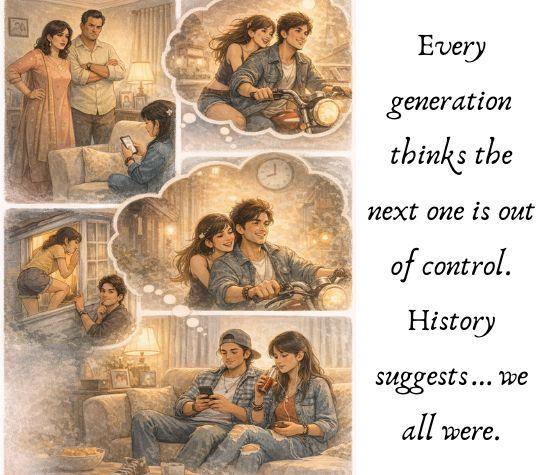
The Great Amnesia: Why Parents Forget Being Teenagers
It’s one of life’s most predictable ironies. A parent stands in a living room, hands on hips, exasperated by their teenager’s choices, late-night chats, or "questionable" fashion sense. They say things like, "I would never have dreamed of doing that at your age."
But here’s the truth: They probably did. Or at least, they did something else that made their parents lose sleep.
The communication gap between parents and teenagers isn't just about different tastes in music or technology; it’s driven by a psychological phenomenon I like to call "Adulthood Amnesia." ---
The "Golden Age" Fallacy
As we age, our brains perform a bit of "selective editing." We tend to remember our teenage selves as more responsible, more logical, and more respectful than we actually were. This is the Golden Age Fallacy. We forget the time we snuck out, the lie we told about where we were going, or the crushing intensity of a first heartbreak that felt like the end of the world. Because we survived those years, we view them through a lens of "it wasn't that bad." This makes it hard to empathise when a teenager is currently drowning in the middle of their own "storm."
The Shift from "Person" to "Protector"
Why do parents forget? Because their role has fundamentally changed.
- Then: Your goal was independence and exploration.
- Now: Your goal is preservation and safety.
When you become a parent, your brain’s "risk assessment" center goes into overdrive. You are so busy trying to prevent your child from making the mistakes you made (or the ones you were lucky enough to avoid) that you forget that making mistakes is how you learned to be an adult in the first place.
The Biological Mismatch
There is a genuine biological "language barrier" happening during these years.
- The Teen Brain: Driven by the Amygdala (the emotional center). It craves intensity, social connection, and risk.
- The Parent Brain: Driven by the Prefrontal Cortex (the logic center). It craves stability, long-term planning, and safety.
When a parent uses "logic" to solve a teenager’s "emotional" problem, the signals cross. The parent thinks they are being helpful; the teenager feels they are being dismissed.
The "Expert Trap"
Parents often feel that because they have "been there," they have the answers. But they fail to realize that the world has changed, even if human nature hasn't. A parent’s teenage experience didn’t involve social media algorithms, 24/7 digital connectivity, or the specific pressures of the 2020s. By acting like an "Expert" rather than a "Student" of their child's life, parents accidentally shut down the conversation. They offer solutions when the teenager just needs a witness.
"The greatest distance between two people is a misunderstanding born of forgotten history."
How to Close the Gap
To fix the silence, parents don't need to be "cool"—they need to be curious.
- Own the Hypocrisy: It’s okay to say, "I did some pretty reckless things at your age, and that’s exactly why I’m worried about you." Honesty builds more bridges than perfection does.
- Validate the Emotion, Even if You Don't Agree with the Logic: You don't have to think their "crisis" is a big deal to acknowledge that it feels like a big deal to them.
- Listen to Understand, Not to Reply: Stop formulating your "lecture" while they are still speaking.
Listen Closely
Parents, your teenagers aren't a "problem to be solved"; they are people to be known. You were once the one breaking the rules, pushing the boundaries, and wishing your parents would just understand. The best way to support your kids today is to stop being a "Director" and start being a "Consultant."
They don't need you to forget who you were—they need you to remember it.