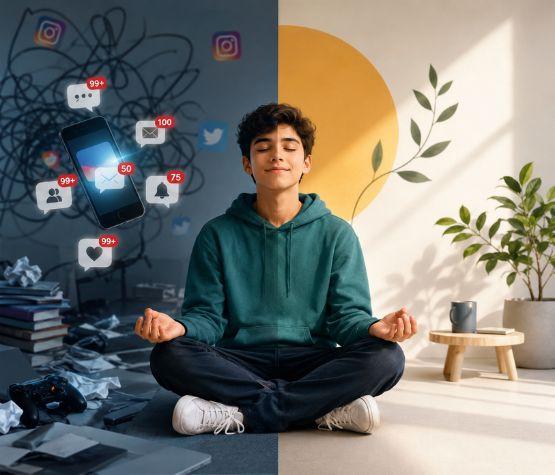
Screen Habits Without the Battle: The "Middle Ground" Strategy for 2026
The conversation around screens has reached a boiling point. For years, the narrative has been polarized: you’re either "addicted" to your device, or you’re on a "digital detox" trying to banish technology entirely.
But for most of us—and especially for the adolescents growing up in a digital-first world—neither extreme is sustainable. We can’t live without these tools, but we are tired of living for them.
It’s time to move past the "screen time" debate and start talking about digital autonomy. Here is how to find the middle ground that preserves both your relationships and your mental health.
-
Shift from "Quantity" to "Quality"
We’ve been obsessed with the number of hours spent on a screen, but not all minutes are created equal. Spending two hours learning a new language or coding a game is fundamentally different from two hours of "doomscrolling" through an algorithmically curated feed.
- The Categorization Rule: Sit down with your teenager (or yourself) and categorize apps into Tools, Crafts, and Consumption.
- Tools (Maps, Calendars, Email) are neutral.
- Crafts (Editing photos, writing, music production) are expansive.
- Consumption (Social scrolling, autoplay videos) is what needs "guardrails," not a total ban.
The "Physical Friction" Strategy
Willpower is a finite resource. Instead of "trying harder" to stay off your phone, change the physical environment. This reduces the cognitive load of making a choice.
- The Charging Station: Phones don't live in bedrooms. They live in a common area "garage" after a certain hour. This isn't a punishment; it’s a physiological boundary for better sleep.
- Greyscale Mode: One of the most effective "middle ground" hacks. By removing the vibrant, dopamine-triggering colors from your screen, the phone becomes a tool again rather than a toy.
- The "One-Screen" Rule: Avoid the "second screen" habit (e.g., scrolling on your phone while watching a movie). Pick one medium and give it your full attention.
Replace "Don't" with "Instead"
The biggest mistake parents and adults make is trying to remove a digital habit without filling the vacuum. If you take away the phone, the brain experiences a "stimulation gap" that feels like physical discomfort.
- High-Dopamine Alternatives: If a teen is used to the fast pace of gaming, a slow board game might feel "boring" initially. Look for high-engagement analog activities—sports, complex puzzles, or fast-paced cooking—to bridge the gap.
- The "Needs" Audit: Ask, What is this screen providing right now? Is it connection? Boredom relief? Stress escape? Once you identify the need, you can find a non-digital way to meet it.
Build "Analog Islands" in Your Day
A total ban feels like a prison, but a "Digital-Free Zone" feels like a sanctuary.
- The First & Last Hour: Protect the first 60 minutes of your day and the last 60 minutes before bed. These are the "Analog Islands" where the outside world (and its demands) aren't allowed to enter.
- Tech-Free Tables: Establish the dinner table or the car as a "No-Fly Zone" for devices. These are the spaces where eye contact and "micro-conversations" happen—the building blocks of relational safety.
The Goal: Moving Toward "Intentional Use"
The "Middle Ground" isn't about being perfect; it’s about agency. When an adolescent (or an adult) can say, "I am choosing to use this app for 20 minutes because I want to see what my friends are doing," and then actually put it down, they have won.
We don't need a revolution against technology. We need a evolution in how we relate to it. By moving away from the "battle" and toward a shared goal of mental clarity, we can finally make our devices work for us, rather than the other way around.
What is the one "Analog Island" in your home that everyone agrees is sacred?