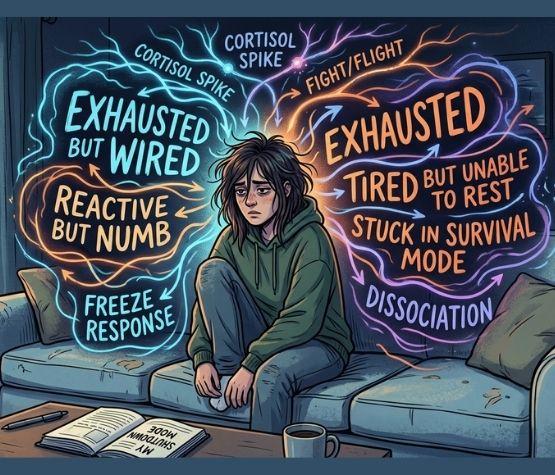
The Silent Hijack: When Your Body Forgets How to Feel Safe
Have you ever felt like you were running a marathon while sitting perfectly still? Or perhaps you’ve experienced that strange, hollow sensation of being "fine" on the outside while feeling like a fraying wire on the inside.
Most people don't realize that their nervous system can become completely dysregulated. We often mistake these physiological states for personality flaws, "burnout," or just a string of bad days. In reality, your body has hijacked the controls to keep you safe from perceived threats, even when the "threat" is just an overflowing inbox or a tense conversation.
The Paradox of Dysregulation
When your nervous system loses its ability to return to a state of calm, you enter a confusing landscape of contradictions:
- Exhausted but Wired: You are physically drained, yet your mind is racing at midnight. You feel a frantic need to do things, but lack the energy to finish them.
- Reactive but Numb: You might snap at a loved one over a small comment, yet feel strangely detached and "checked out" during moments that should feel meaningful.
- Tired but Unable to Rest: Sleep doesn't feel like recovery; it feels like a temporary lapse in consciousness. You wake up feeling just as heavy as when you laid down.
Stuck in "Survival Mode"
Being stuck in survival mode means your Vagus Nerve and your Sympathetic Nervous System are out of sync. You aren't living; you are reacting. You feel disconnected from your intuition because your brain has prioritized survival over connection.
When you're in this state, "just relaxing" feels impossible—or even dangerous—to your body. To find your way out, you have to stop blaming your mindset and start tending to your biology.
Why Your Mind Can’t "Logic" Its Way Out
The most frustrating part of a dysregulated nervous system is that your logical brain (the prefrontal cortex) knows you are safe, but your survival brain (the limbic system) doesn't believe it.
You can tell yourself "there’s nothing to worry about" a thousand times, but if your heart is racing and your muscles are tight, your body is sending a much louder message: "Danger is here." When your body forgets how to feel safe, it stops looking for connection and starts looking for threats. You become:
- Hyper-vigilant: Misinterpreting a partner’s quiet mood as anger.
- Reactive: Snapping at a colleague over a minor piece of feedback.
- Isolated: Withdrawing from social life because "peopling" feels like a threat to your limited energy.
Reclaiming Your Internal Safety
Healing from a Silent Hijack isn't about "thinking positive." It’s about somatic re-education—teaching your body, through physical experience, that the crisis is over.
- Acknowledge the Hijack: Stop blaming your "personality" for your anxiety. Recognize it as a physiological state. “My body feels unsafe right now, even though I am in a safe room.”
- Focus on the "Felt Sense": Instead of analyzing why you feel bad, notice where you feel it. Is it a tightness in the chest? A knot in the stomach? Gently bring your breath to that area without trying to change it.
- Micro-Moments of Safety: Find small, sensory anchors. The warmth of a cup of tea, the weight of a blanket, or the sound of a familiar song. These are "glimmers" that remind your nervous system that it's okay to let its guard down.
The Way Back
Finding your way out of survival mode is a slow process of building a "Quiet Architecture" within yourself. It’s about moving from a life of reacting to a life of responding.
Your body didn't choose to forget how to feel safe; it was just trying to protect you. Now, you can gently show it that the war is over, and it's finally time to come home.