The 'Lean In' Era is Over. Welcome to the Era of the New Network
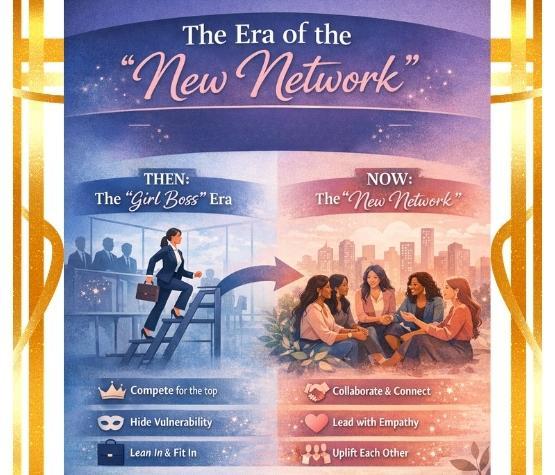
For decades, we were told that to succeed, we had to play by the rules of a game we didn't design. We were told to "lean in," to be more assertive, to hide our vulnerability, and to view other women as competitors for the one "token" spot in the boardroom.
But something shifted over the last few years. The "Girl Boss" era ended, and the "New Network" began.
Beyond the Solo Success Story
We are moving away from the "Self-Made" myth. In 2026, no one is truly self-made. We are community-made. The most successful women I know aren't the ones hoarding their contacts or working 18-hour days in isolation. They are the ones building "Micro-Communities"—small, high-trust circles where information is shared freely, and one woman’s win is viewed as a blueprint for everyone else.
The Power of Soft Skills in a Hard-Tech World
As AI and automation take over the "logical" and "repetitive" tasks of our lives, the skills that were once dismissed as "soft" are becoming the most valuable assets in the global economy:
- Empathy: The ability to understand what a client actually needs before they say it.
- Collaboration: Building teams where everyone feels safe enough to innovate.
- Intuition: Knowing when a project feels "off," even if the data says it’s fine.
These aren't just "women’s traits"—they are Human Power Skills. And for too long, women were told to downplay them. In 2026, we are finally leaning into them as our greatest strengths.
Redefining "The Table"
We no longer want to just "fit in" to existing structures. We are building our own:
- We are creating businesses that prioritize well-being over infinite scale.
- We are establishing mentorships that feel like partnerships, not hierarchies.
- We are realizing that our value isn't tied to our "productivity," but to our perspective.
A Letter to the Next Generation
To the young women entering the workforce or starting their first creative project today: You do not have to harden yourself to be taken seriously.
The world doesn't need more people who act like machines; it needs more people who lead like humans. Your ability to connect, to care, and to build community isn't a distraction from your work—it is the work.
This Women's Day, Let’s Trade "Hustle" for "Harmony"
Let’s stop asking "How can I do more?" and start asking "Who can I lift with me?"
Because when one woman decides to work differently, she gives permission for every woman in her orbit to do the same. That is how we change the world—not through one massive explosion, but through a million quiet shifts in how we treat ourselves and each other.