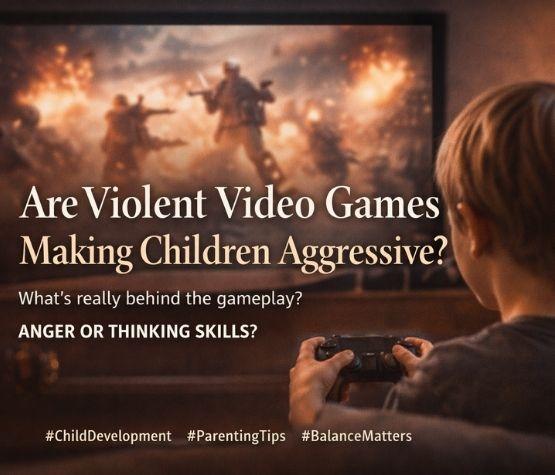
Are Violent Video Games Making Children Aggressive?
Your child is deeply focused on a fast-paced game. There’s combat, competition, intensity.
And you wonder:
Is this building aggression? Or building skills?
Violent video games do not automatically make children aggressive.
But they can increase short-term emotional arousal — especially in children who already struggle with regulation.
The difference lies in guidance, boundaries, and personality.
What Research Actually Shows
Studies on violent video games and child behavior suggest:
- They may temporarily increase aggressive thoughts right after gameplay.
- There is no strong evidence linking them to long-term violent behavior in most children.
- Parenting style, emotional security, and environment play a much larger role.
In simple terms:
Games don’t create aggression. They may amplify what’s already unregulated.
The Skills We Often Overlook
Action games can also improve:
- Strategic thinking
- Problem-solving under pressure
- Hand–eye coordination
- Persistence after failure
Children learn to adapt quickly, think ahead, and try again after losing.
That’s not aggression. That’s cognitive training.
When Should Parents Be Concerned?
Gaming becomes problematic when:
- Screen time is excessive
- Sleep and academics suffer
- Irritability continues long after playing
- The child cannot handle losing calmly
That’s usually a regulation issue — not a “video game problem.”
The Real Determining Factor
The biggest influence is not the game.
It’s whether the child has:
- Emotional guidance
- Healthy boundaries
- Open conversations at home
Games stimulate the brain. Parents shape emotional control.
Let’s Pause Here
Violent video games are not silent villains — nor are they miracle tools.
In moderation, with supervision, they can sharpen thinking. Without limits, they can overstimulate.
The goal isn’t fear, It’s balance.
And your presence matters far more than the pixels on a screen.